.png.webp)


RobiX-Nav: Accelerating Autonomous Navigation Research with an Open Mobile Robotics Platform


● Autonomous navigation has advanced rapidly over the past decade, driven by breakthroughs in perception, artificial intelligence, and robotics software. From warehouse automation and campus delivery to industrial inspection and service robotics, autonomous mobile robots are becoming an essential part of modern intelligent systems. Yet despite the rapid evolution of algorithms, one challenge remains consistent across research laboratories and development teams: finding a mobile platform capable of supporting real-world experimentation without sacrificing flexibility.
●Many robotics developers begin their work in simulation, where new algorithms for localization, mapping, path planning, and obstacle avoidance can be developed quickly. However, moving these algorithms from simulation into physical environments often introduces unexpected challenges. A research platform must provide reliable mobility, sufficient payload for multiple sensors and computing devices, an open software ecosystem, and enough flexibility to accommodate changing project requirements. Lightweight educational robots frequently lack the carrying capacity for advanced hardware, while industrial autonomous vehicles are often larger, more expensive, and less adaptable than most research projects require.
RobiX-Nav was designed to bridge this gap.
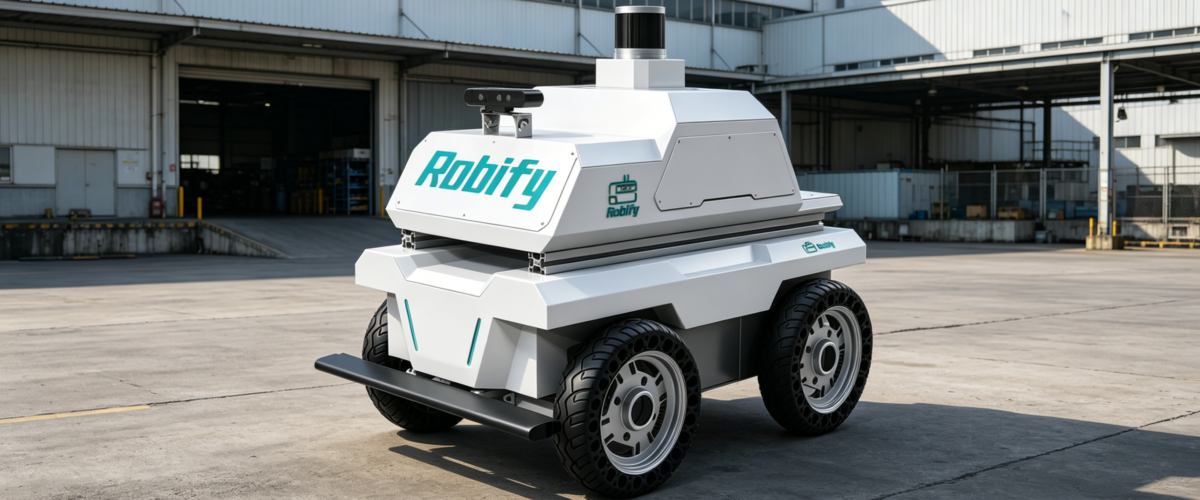
● Built around the RobiX four-wheel differential steering mobile base, RobiX-Nav combines robust mobility with integrated perception hardware and an open development architecture. Rather than serving as a single-purpose autonomous vehicle, it functions as a complete research platform that enables developers to focus on software innovation instead of hardware integration. Whether the goal is developing a new SLAM algorithm, validating autonomous navigation strategies, or building an intelligent inspection system, RobiX-Nav provides a reliable foundation for experimentation.
● At the heart of the platform is its four-wheel differential steering system, which combines precise maneuverability with stable motion control. The vehicle supports in-place rotation, allowing it to operate efficiently in confined indoor environments such as laboratories, office buildings, and warehouses while maintaining smooth navigation across larger open spaces. Powered by brushless DC hub motors and coordinated by an integrated Vehicle Control Unit (VCU), the platform delivers accurate closed-loop control for both manual operation and autonomous driving. This combination enables researchers to evaluate navigation algorithms under realistic operating conditions without being limited by the underlying hardware.
● Another defining characteristic of RobiX-Nav is its payload capacity. Modern autonomous robots rarely operate with a single sensor. A typical research system may simultaneously integrate a 3D LiDAR, RGB-D depth camera, RTK positioning module, industrial computer, wireless communication hardware, and application-specific equipment. Supporting this level of integration requires considerably more structural capacity than traditional educational mobile robots can provide. With an 80 kg payload capacity, RobiX-Nav allows developers to build sophisticated multi-sensor systems while maintaining stable vehicle performance, making it suitable for both academic research and industrial prototyping.
● The platform is equally focused on perception. RobiX-Nav integrates a comprehensive sensor suite designed for autonomous navigation and environmental understanding. A 32-channel 3D LiDAR captures accurate spatial information for mapping and localization, while RGB-D cameras provide depth perception for visual recognition and obstacle detection. High-precision wheel encoders and inertial sensing contribute additional motion data, enabling reliable sensor fusion for localization and trajectory estimation. Together, these components provide the perception foundation required for SLAM, autonomous navigation, obstacle avoidance, and intelligent robotic decision-making.
● Recognizing that every robotics project has unique computational requirements, RobiX-Nav also embraces an open hardware architecture. The platform supports NVIDIA Orin series computing modules for edge AI applications while maintaining compatibility with standard industrial communication interfaces including CAN, RS-232, and RS-485. Native support for ROS, together with compatibility with both Windows and Ubuntu operating systems, allows developers to integrate the platform into existing robotics workflows with minimal configuration. Instead of forcing users into a proprietary ecosystem, RobiX-Nav is designed to adapt to the software stack and hardware architecture already familiar to research teams.


● Power requirements also vary significantly between different applications. Some projects prioritize lightweight mobility for short laboratory experiments, while others require extended operation for outdoor testing or long-duration inspection tasks. To accommodate these diverse deployment scenarios, RobiX-Nav offers customizable battery configurations, allowing runtime to be tailored according to application requirements. This flexibility enables users to optimize the balance between operating time, payload, and overall system performance rather than relying on a fixed power configuration.
● The versatility of RobiX-Nav enables deployment across a wide range of robotics applications. In autonomous navigation research, it provides a complete hardware platform for validating localization, mapping, path planning, and multi-sensor fusion algorithms in real environments. Universities and research institutions can use the platform to support coursework and experimental projects in robotics, artificial intelligence, and autonomous systems without investing significant engineering effort into custom vehicle development. Industrial developers can integrate specialized sensors to create intelligent inspection robots capable of monitoring factories, campuses, warehouses, and infrastructure facilities. For logistics research, the platform's payload capacity and open architecture make it suitable for investigating autonomous material transportation and fleet management strategies.
● As robotics continues to expand beyond controlled laboratory settings into increasingly dynamic environments, development platforms must evolve alongside the algorithms they support. Researchers need hardware that is reliable enough for continuous experimentation, flexible enough to accommodate changing system architectures, and powerful enough to support next-generation perception and computing technologies.
● RobiX-Nav was developed with this philosophy in mind. By combining the proven mobility of the RobiHaul2.0 mobile base with integrated sensing, expandable computing, customizable power solutions, and an open ROS ecosystem, it provides more than a mobile robot—it delivers a versatile development platform for autonomous navigation research. Whether deployed in universities, research laboratories, or industrial innovation teams, RobiX-Nav helps bridge the gap between simulation and real-world robotic autonomy, enabling developers to transform ideas into practical intelligent systems with greater speed and confidence.