.png.webp)


Mastering Low-Latency Teleoperation: Building an Exoskeleton Control Pipeline for AgileX Piper


1. Why Exoskeleton Teleoperation for Embodied AI?
Collecting high-quality demonstration data for robotic manipulation usually relies on three main teleoperation methods:
1. VR Controllers / SpaceMouse: ● Drawback: Lacks direct joint-space mapping. Controlling a 6-DOF arm with a 3D mouse or VR joystick often leads to awkward joint singularities, making fine-grained tasks (like delicate insertion or assembly) unnatural for operators.
2. Leader-Follower Arm Setup (Dual Arms): ● Drawback: Highly accurate, but requires purchasing or mounting an identical twin robotic arm. This doubles hardware costs, takes up significant physical space, and causes operator fatigue during long data-collection sessions.
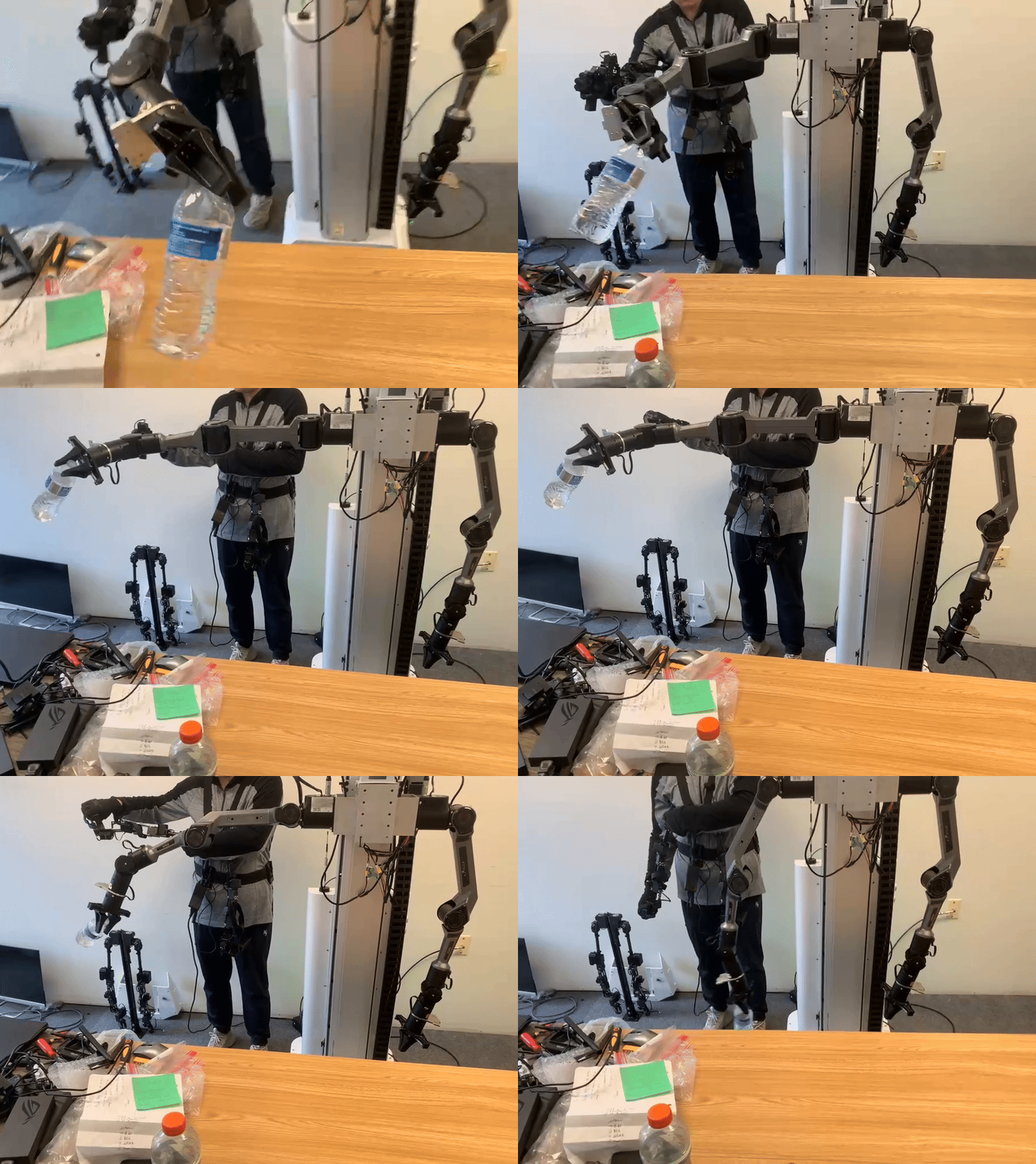
3. Upper-Limb Wearable/Desktop Exoskeleton: ● Advantage: Maps human arm joint movements 1:1 directly to the slave robotic arm. It offers high dexterity, natural ergonomics, sub-50ms low latency, and realistic motion feedback—making it the ideal choice for collecting large-scale imitation learning datasets.

2. System Architecture & Telemetry Pipeline
The piper-exo-teleop framework establishes a real-time, closed-loop telemetry pipeline between the exoskeleton master device and the AgileX Piper follower arm.

3.Kinematic Mapping Made Simple
Instead of solving complex 3D Inverse Kinematics (IK) in real-time, the exoskeleton system uses Direct Joint Mapping:
1. Zero Calibration: ● When starting up, the system reads the zero-position offsets between the human operator's arm and the robot's physical home position.
2. Direction Alignment: ● Each joint angle from the exoskeleton encoders is scaled and aligned with the movement polarity (clockwise vs. counter-clockwise) of the corresponding Piper joint.
3. Soft Limit Clamping: ● Every commanded joint angle is automatically clamped inside the safe physical motion range of the Piper arm to prevent mechanical over-extension.
4.Multi-Threaded Low-Latency Design
To achieve a silky-smooth 50Hz–100Hz control loop without lag, the software uses a decoupled multi-thread architecture:
1. Thread 1 (CAN Receiver): ● Continuously reads raw encoder frames from the exoskeleton over the CAN bus (can0) at 1,000,000 bps.
2. Thread 2 (Filter & Safety Engine): ● Cleans up high-frequency human hand tremors using a light moving-average filter and checks for unsafe motion spikes.
3. Thread 3 (Piper Publisher): ● Every commanded joint angle is automatically clamped inside the safe physical motion range of the Piper arm to prevent mechanical over-extension.
5.Step-by-Step Setup & Deployment
Step 1 : System Requirements & Installation
●OS: Ubuntu 20.04 / 22.04 LTS
●Python: Python 3.8+
●Hardware: AgileX Piper Arm, USB-to-CAN Adapter (e.g., CandleLight), Compatible Exoskeleton Master.
Clone the repository and install dependencies:

Step 2 : Bring up the CAN interface (can0) with a bitrate of 1,000,000 bps (1 Mbps):
Bring up the CAN interface (can0) with a bitrate of 1,000,000 bps (1 Mbps):

Step 3: Pre-Flight Safety & Calibration Protocol
Before powering on high-torque motor drives, follow these basic safety steps:
●Power-On: Power the AgileX Piper arm and connect the USB-to-CAN adapter to your workstation.
●Pose Matching: Manually position the exoskeleton master so its shape roughly matches the home position of the Piper arm (keep joint angle differences within 30°).
●Zero Check: Run the zero-check tool to verify encoder signals:

Step 4 : Launch Real-Time Teleoperation
Run the main control node:

Move your arm wearing/holding the exoskeleton, and the AgileX Piper arm will mirror your actions instantly with zero noticeable lag!
6. Hardware Protection & Safety Safeguards
Operating physical hardware requires active software fail-safes to protect gearboxes and personnel:
1. Startup Pose Guard: ● If the position gap between the master device and the robot arm is too large at launch, the system refuses to enable teleoperation to avoid sudden violent arm snaps.
2. Speed Limiting: ● Maximum joint speeds are capped automatically, ensuring movements remain controllable even during fast human gestures.
3. Communication Timeout: ● If CAN communication freezes or loses packets for longer than 100ms, the controller automatically locks the robot joints and stops movement safely.
7. Next Steps: Dataset Collection for Embodied AI
Beyond real-time control, this teleoperation pipeline serves as a foundation for Imitation Learning (IL):
1. Dataset Recording: ● Save master/follower joint trajectories, gripper states, and multi-camera RGB-D video feeds into standardized HDF5 datasets.
2. Model Training: ● Feed recorded demonstration datasets directly into Action Chunking with Transformers (ACT), Diffusion Policy, or Hugging Face LeRobot to train fully autonomous AI policies.
Resources & References
1. GitHub Repository: ● ZiiYuuuu/piper-exo-teleop
2. Speed Limiting: ● AgileX Piper 6-DOF Lightweight Manipulator
3. Communication Timeout: ● https://github.com/agilexrobotics/piper_sdk?utm_source=gemini
If this project helps your robotics research or data collection pipelines, consider starring the repository on GitHub!


