.png.webp)


AGV vs AMR: How to Choose the Right Navigation Model for Your Facility


A facility manager does not experience the difference between an AGV and an AMR as a vocabulary problem. The difference appears when a pallet blocks an aisle, a production cell moves, a pickup point changes, or a robot arrives at a conveyor with the wrong alignment. In those moments, the navigation model determines whether the system waits, reroutes, requires engineering work, or continues within an approved operating plan.
That is why an AGV vs AMR decision should begin with the transport process—not with a product label. Automated guided vehicles and autonomous mobile robots can move similar loads and may use overlapping sensors, drive bases, and software. What separates them in practice is how routes are defined, how exceptions are handled, and how much decision-making is assigned to the vehicle.
This guide provides a facility-level framework for choosing between guided and autonomous navigation without assuming that one technology is universally better.
AGV vs AMR: The Difference Is the Navigation Contract
A traditional automated guided vehicle follows a predefined route or route network. Guidance may come from magnetic tape, embedded wire, reflectors, QR markers, or a software-defined path. The important point is not the specific guidance technology; it is that the vehicle is expected to execute an approved path with limited freedom to choose a different one.
An autonomous mobile robot localizes itself within a mapped operating area and plans a path between task endpoints. It still follows traffic rules, speed limits, restricted zones, and safety constraints, but it can normally select among valid paths rather than relying on one fixed line.
The distinction is therefore better expressed as a navigation contract:
- AGV contract: follow the route assigned by the system and stop or wait when that route cannot be used.
- AMR contract: reach the assigned destination by selecting a valid path within defined operational constraints.
Real products can sit between these definitions. A vehicle may use LiDAR localization but remain confined to virtual lanes. An autonomous platform may also be restricted to fixed corridors because of safety, process control, or traffic policy. Sensors alone do not decide whether a deployment behaves like an AGV or an AMR.
| Decision Area | AGV-Oriented Deployment | AMR-Oriented Deployment |
|---|---|---|
| Route definition | Predefined paths or route graph | Dynamic path planning inside an approved map |
| Facility infrastructure | May use physical guides, markers, or fixed virtual routes | Usually relies on maps, onboard sensing, and software-defined zones |
| Blocked path | Typically stops, waits, or requests intervention | May calculate another permitted path when conditions allow |
| Layout changes | Often require route engineering and recommissioning | Often handled through map, zone, and mission updates |
| Traffic behavior | Predictable movement along controlled lanes | Flexible movement with greater dependence on traffic logic |
| Strongest fit | Stable, repetitive point-to-point flow | Variable destinations, changing layouts, and frequent exceptions |
Start with the Transport Process, Not the Robot
Before comparing vehicles, document the work that the vehicle must perform. A route drawing is not enough. Record the material, pickup and drop-off interfaces, task frequency, allowed waiting time, traffic conditions, charging window, recovery procedure, and system that creates each mission.
How stable are the routes?
If the same material moves between the same two stations for years, a guided route can be an advantage. It creates a controlled traffic pattern that operators can understand and engineers can validate. The apparent rigidity is useful when the process itself is rigid.
If destinations change by shift, product, or order profile, route flexibility becomes more valuable. Frequent layout changes can turn physical guide changes and route recommissioning into recurring costs. An AMR can reduce that change burden when maps and missions are managed well.
What happens when the normal path is unavailable?
Do not ask only whether a robot can avoid an obstacle. Ask what it is permitted to do next. Can it use a parallel aisle? May it cross a pedestrian zone? Can it enter another vehicle’s corridor? Should it wait because an alternate route would disrupt a safety-controlled process?
An AMR’s ability to replan is valuable only when the facility provides valid alternatives. In a single narrow aisle, dynamic navigation cannot create a second path. Conversely, an AGV that waits for a short, predictable blockage may be entirely adequate.
How much traffic variability exists?
Mixed traffic changes the calculation. Forklifts, carts, temporary pallets, open doors, people, and staging activity can make a route unpredictable. AMR-style navigation may reduce blockage time, but it also requires careful zone design, congestion management, and fleet coordination.
A controlled lane can simplify traffic even in a busy facility. Separating people and vehicles, defining crossing points, and making robot behavior obvious may deliver more value than adding route freedom. Navigation capability should support the traffic plan rather than substitute for one.
How precise are the handoffs?
Material transfer usually determines whether a mobile robot project succeeds. Conveyors, racks, lifts, robotic arms, and carts each impose alignment, height, timing, and communication requirements. A robot can navigate successfully through the building and still fail the process if docking is inconsistent.
Specify the permitted position and heading error at every station. Then verify approach direction, stopping behavior, load shift, sensor visibility, retry logic, and what happens when the station is occupied. These requirements affect chassis geometry and controls regardless of whether the platform is called an AGV or an AMR.
When an AGV Is the Better Engineering Choice
An AGV-oriented design is often appropriate when routes and tasks are stable, station interfaces are fixed, and changes are infrequent. It can make traffic easier to predict and reduce the number of path-planning decisions that must be validated.
Consider guided navigation when most of the following conditions are true:
- Transport is repetitive and point-to-point.
- Production layout and station locations rarely change.
- Dedicated or clearly controlled lanes are available.
- Alternate routes provide little operational benefit.
- Predictable arrival patterns matter more than route flexibility.
- The maintenance team prefers a limited, tightly governed route network.
This does not mean an AGV must be technically simple. A modern guided vehicle can use safety scanners, LiDAR localization, fleet software, automatic charging, and detailed telemetry. The deciding factor remains how the vehicle is expected to navigate and respond to change.
When AMR Flexibility Earns Its Complexity
An AMR-oriented design becomes attractive when task endpoints change, obstacles are common, or the facility needs to expand automation without repeatedly modifying route infrastructure. Its value comes from operational adaptability, not from autonomy as a marketing feature.
Consider autonomous navigation when several of these conditions apply:
- Robots serve many pickup and delivery points.
- Routes change with orders, production cells, or inventory locations.
- Multiple valid paths exist around common blockages.
- The operation will scale in phases or add destinations frequently.
- Software teams can manage maps, missions, traffic rules, and updates.
- Manual interventions caused by blocked fixed routes would be costly.
Flexibility creates new engineering responsibilities. Maps require governance. Traffic rules need testing. Software updates can affect path behavior. Recovery procedures must cover localization loss, blocked charging stations, network interruptions, and missions that cannot be completed. An AMR is not infrastructure-free; much of its infrastructure is digital.
Seven Questions for an AGV vs AMR Decision
- What percentage of missions use the same endpoints? Stable endpoints favor a controlled route; variable endpoints increase the value of autonomous planning.
- How often does the physical layout change? Include rack moves, temporary staging, seasonal reconfiguration, and new production cells—not only major renovations.
- Are alternate paths actually available? Route planning has limited value when the process contains single-lane bottlenecks.
- What is the cost of a blocked mission? Measure lost production, manual recovery time, downstream waiting, and the probability of repeated blockage.
- How will missions enter the fleet? Define interfaces with the WMS, MES, ERP, call buttons, PLCs, conveyors, doors, elevators, and charging system.
- Who owns changes after launch? Assign responsibility for maps, routes, traffic zones, user permissions, software versions, backups, and incident review.
- What must be proven for safe operation? Treat the vehicle, control system, operating zone, and human workflow as one system. Relevant deployments should be assessed against applicable requirements such as ISO 3691-4:2023 and local regulations.

Why Modern Product Labels Can Blur
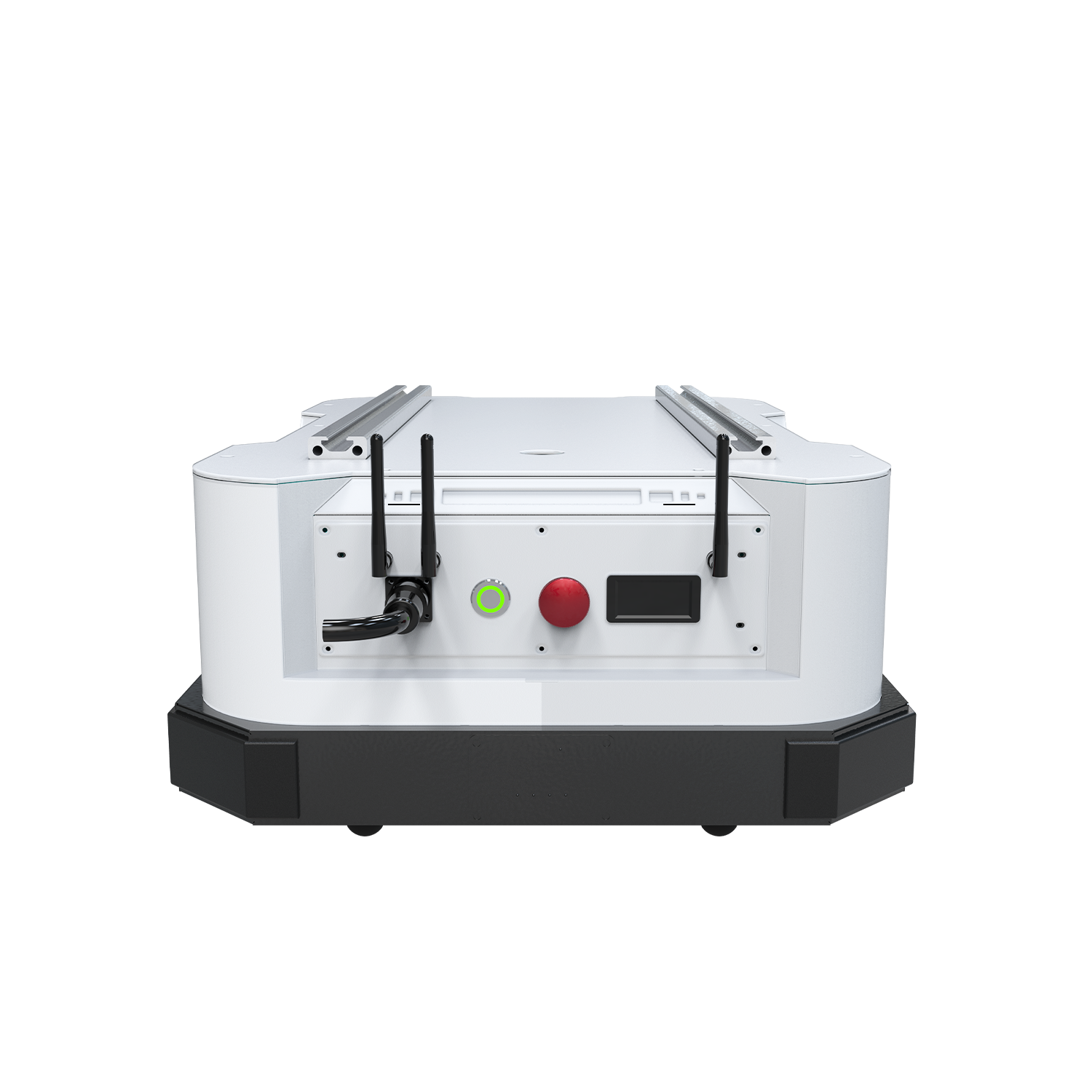
Robify’s current AGV platform category illustrates why buyers should qualify behavior rather than rely on names. Both RobiHaul 1.0 and RobiHaul 2.0 are listed as AGV products, while their live descriptions also reference laser navigation, adaptive path planning, autonomous operation, or AMR expansion.

This overlap is not unique to one manufacturer. Industry terminology has evolved as guided vehicles gained mapping and sensing capabilities and autonomous platforms adopted controlled lanes. A useful request for proposal should therefore describe required behavior directly:
- How is the vehicle localized?
- Who defines the path—the vehicle, the fleet manager, or a fixed guide?
- Can the vehicle replan, and inside which zones?
- What triggers a stop, reroute, mission cancellation, or operator call?
- How are route, map, and software changes approved and rolled back?
For a closer look at the platform-focused story, the existing RobiHaul 2.0 engineering overview discusses warehouse mobility and integration. The decision framework here serves a different purpose: choosing the navigation model before selecting a configuration.
Run a Pilot That Tests Exceptions, Not Just Nominal Travel
A successful demonstration in an empty aisle proves very little. The pilot should reproduce the events that create operational risk.
Establish the baseline
Measure the current manual or automated process before introducing the robot. Record missions per hour, travel distance, wait time, failed handoffs, manual interventions, peak congestion, and labor required for recovery. Without a baseline, a pilot can show movement but not improvement.
Test normal and degraded conditions
Run the expected mission mix at realistic traffic levels. Then introduce controlled exceptions: a blocked aisle, a moved pallet, an unavailable station, a closed door, a delayed conveyor, a charging conflict, and a temporary network interruption. Confirm whether the vehicle waits, reroutes, retries, or escalates as designed.
Verify interfaces and recovery
Test every handoff, mission source, status message, and operator action. Recovery time matters as much as nominal cycle time. A system that requires a specialist for common faults can produce a high support burden even when navigation performance is strong.
Measure lifecycle change effort
During the pilot, change one route and one destination. Record the engineering time, production interruption, validation work, documentation updates, and training required. This exercise reveals the practical difference between guided and autonomous navigation better than a feature list.
Review the wider range of Robify mobile robot platforms only after the process requirements are written. If the required sensors, interfaces, chassis, or workflow fall between standard configurations, Robify’s robot customization and integration process can be evaluated against the same pilot criteria.
Frequently Asked Questions
Is an AMR always better than an AGV?
No. An AMR provides route flexibility, but flexibility adds software, traffic-management, testing, and governance requirements. A stable point-to-point process may benefit more from the predictability of guided navigation.
Can an AGV use LiDAR or SLAM?
Yes. Modern AGVs can use LiDAR, mapping, and software-defined routes. The sensor set does not determine the category by itself. Ask how paths are assigned and what the vehicle is allowed to do when its route is blocked.
Does an AMR eliminate route planning?
No. AMRs still need mapped operating zones, traffic rules, restricted areas, speed limits, station approaches, and recovery logic. They choose among permitted paths; they do not operate without constraints.
What should an AGV or AMR pilot measure?
Measure mission completion, cycle time, blockage delay, manual interventions, docking repeatability, congestion, recovery time, charging behavior, interface reliability, and the effort required to change a route or destination.
Can AGVs and AMRs operate in the same facility?
They can, but coexistence is a system-integration problem. Shared zones need coordinated traffic rules, clear ownership between fleet systems, compatible status exchange where required, and a facility-level safety assessment. Do not assume that vehicles from different systems are automatically aware of one another.
Choose the Navigation Model Before Choosing the Vehicle
The right AGV vs AMR decision follows from the operating model. Choose guided navigation when stable routes, controlled traffic, and predictable handoffs are the priority. Choose autonomous navigation when changing destinations, viable alternate paths, and frequent process changes justify the additional software and governance.
Most importantly, write the required behavior in measurable terms. Define what the vehicle must do during normal travel, congestion, blocked paths, failed handoffs, charging, and recovery. Once those conditions are clear, the product label becomes less important—and the engineering decision becomes much easier to verify.