.png.webp)


Differential Drive vs Omnidirectional Mobile Robots: Which Chassis Fits Your Workspace?


Choosing a mobile robot chassis is easy when the workspace is an open floor. The decision becomes much harder when the robot has to pass through narrow aisles, align with a shelf, approach equipment from the side, carry a manipulator, or repeatedly dock within a confined area.
That is where the differential drive vs omnidirectional robot decision matters. Both architectures can work well for autonomous navigation, research and industrial automation, but they solve the problem of movement in very different ways. A differential-drive platform usually offers simpler mechanics and predictable motion, while an omnidirectional platform can provide more freedom when the robot needs to reposition without following a conventional forward-turn-forward path.
The better chassis is therefore not the one with the most impressive mobility demo. It is the one whose movement matches the geometry and tasks of your actual workspace.
Differential Drive vs Omnidirectional Robot: The Core Difference
A differential-drive robot controls motion primarily by changing the relative speed of wheels on its left and right sides. When both sides move at the same speed, the robot travels forward or backward. When one side moves faster, the robot follows a curve. If the two sides move in opposite directions, many differential-drive platforms can rotate around a very small turning radius or even pivot approximately in place.
What a conventional differential-drive robot cannot do is translate directly sideways while keeping the same body orientation. If it needs to move 30 centimeters to the left, it normally has to rotate, drive through a short path and then correct its heading.
An omnidirectional mobile robot is designed to reduce that constraint. Depending on the wheel and steering architecture, the platform may be able to move laterally, diagonally or change its travel direction with less body rotation.
It is important, however, not to treat “omnidirectional” as one single mechanical design. Mecanum wheels, omni wheels and independently steered wheel modules achieve multidirectional motion differently. Their traction, control requirements, maintenance and behavior on real floors can also be very different.
| Decision Factor | Differential Drive | Omnidirectional |
|---|---|---|
| Forward and reverse travel | Natural and straightforward | Natural and straightforward |
| Direct lateral movement | Generally not available | Possible on suitable architectures |
| In-place rotation | Available on many designs | Available on many designs |
| Mechanical complexity | Usually lower | Usually higher |
| Motion-control complexity | Relatively straightforward | Depends heavily on wheel and steering design |
| Tight side docking | May require additional repositioning | Can reduce repositioning when lateral motion is supported |
| Long aisle navigation | Well suited | Well suited, although extra mobility may not always be necessary |
| Mobile manipulation | Effective when approach paths provide enough room | Useful when base pose and side approach are tightly constrained |
Why Workspace Geometry Should Drive the Decision
The biggest mistake in chassis selection is evaluating turning radius without evaluating the entire maneuvering envelope.
Imagine a robot traveling through a warehouse aisle. If it only needs to move forward, stop at predefined stations and occasionally turn into another aisle, a differential-drive platform may already have all the mobility the application requires. Adding lateral motion does not automatically improve the job.
Now imagine the same robot must align itself precisely with several storage racks while pallets, carts or machines leave very little space in front of and behind it. A platform that can translate sideways may reach the required pose without performing several forward-and-backward corrections.
This difference becomes even more important when the mobile base carries a robotic arm. A navigation system may successfully bring the robot close to a workstation, yet the manipulator still needs the base to stop within a useful position and orientation. Extra base mobility can give the system another way to solve that positioning problem.
Where Differential Drive Makes Sense
Differential drive remains one of the most practical choices for mobile robotics because its movement is easy to understand, model and test. For laboratories, prototype development and many AGV or AMR applications, that simplicity has real engineering value.
A differential platform is particularly attractive when most routes follow corridors, aisles or point-to-point paths. If there is enough open space at intersections and docking stations, the inability to move directly sideways may have little effect on productivity.
There is also less reason to pay for additional steering mechanisms if the navigation task does not use them. A more mechanically elaborate chassis still needs to be calibrated, controlled and maintained, even when most of its operating time is spent moving straight down an aisle.
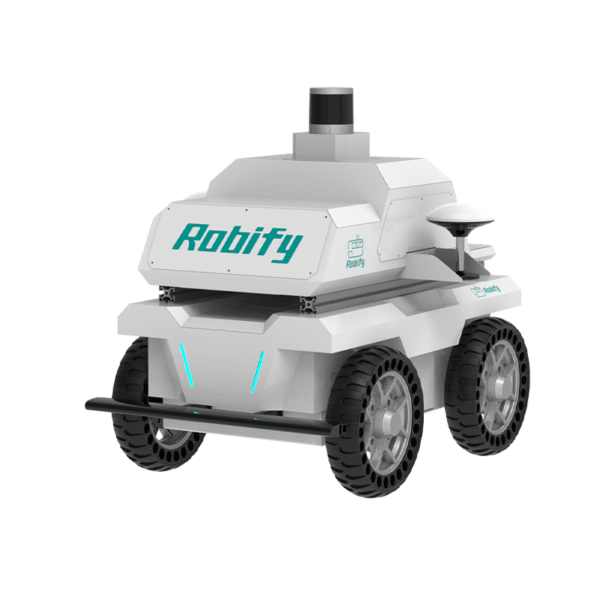
Robify’s RobiHaul 1.0, for example, is described as using a dual-wheel differential chassis and is intended for autonomous navigation applications such as laboratory and warehouse environments.
The RobiX Four-Wheel Differential Mobile Platform provides another differential-drive example. Robify describes this chassis as using four independently speed-controlled wheels, making it useful for teams evaluating four-wheel differential motion, navigation and motion-control applications.
Where Omnidirectional Mobility Becomes Valuable
Omnidirectional movement becomes more compelling when the robot’s final pose matters almost as much as its destination.
Consider a robot entering a compact workcell. It may have enough room to reach the correct area but not enough space to perform a conventional turn before approaching a fixture. If the chassis can translate laterally or coordinate independent steering, the planner gains additional ways to position the robot.
This can be useful around production equipment, laboratory benches, shelves and mobile manipulation stations where the robot needs to preserve its body orientation while adjusting its position.

Robify’s RobiOmni is an example of this approach. Rather than using Mecanum rollers, its current product description identifies a four-wheel independent steering architecture. That distinction matters because different omnidirectional mechanisms behave differently in terms of steering, traction and control.
Do Not Confuse Zero Turning Radius With Omnidirectional Motion
One reason the comparison becomes confusing is that both chassis types may be able to rotate in place.
A differential-drive robot can often counter-rotate its left and right wheels and turn around its center. An omnidirectional platform may also rotate around its center. Seeing both robots perform a 360-degree rotation therefore does not tell you whether one can translate directly sideways.
The more useful question is whether the platform can change its x and y position independently of its body heading. If your workspace regularly requires that behavior, multidirectional mobility can reduce the amount of repositioning needed. If it does not, zero-radius rotation on a simpler differential chassis may already solve the space problem.
Control Software Matters as Much as the Chassis
Extra mechanical freedom only helps when the navigation and control stack can use it.
If your decision also involves route behavior rather than chassis kinematics, Robify’s AGV vs AMR guide covers how fixed-route and dynamically planned navigation models differ at the facility level.
Differential-drive kinematics are widely understood, and planners can represent the robot’s movement using a relatively simple relationship between left-side and right-side wheel motion. This makes the architecture attractive when a team wants a predictable platform for SLAM, autonomous navigation, path planning or robotics education.
An omnidirectional robot may expose additional translational and steering commands. The controller must coordinate those degrees of freedom correctly, and the planner must generate trajectories that actually take advantage of them. If the software treats an omnidirectional chassis exactly like a differential robot, much of the additional mobility can remain unused.
Teams should therefore evaluate the complete software path from the high-level planner to the chassis controller. ROS compatibility alone does not answer whether lateral velocity, steering angles, odometry and the intended motion model are properly supported.
Floor Conditions Can Change the Answer
Workspace geometry is only half of the problem. The floor itself matters.
Some omnidirectional architectures use rollers or multiple contact directions to generate lateral forces. Others use conventional wheels with independent steering. Those designs should not be expected to behave identically on expansion joints, uneven floors, debris, ramps or outdoor surfaces.
Differential and skid-steer platforms also have trade-offs. Turning can create tire scrub because wheels are being forced through different paths, and the effect becomes more noticeable as vehicle weight, tire grip and wheelbase change.
Instead of asking which drive type has “better traction,” evaluate the actual wheel design, tire material, ground clearance, suspension, expected payload and floor surface of the specific platform.
Think About Docking, Not Just Navigation
A robot can navigate successfully and still struggle during the last meter of a task.
Charging docks, conveyors, shelves and machine interfaces often impose tighter positional constraints than the route leading to them. This is where the difference between the two chassis types becomes operationally visible.
A differential robot approaching a dock at the wrong lateral offset may need to reverse and realign. An omnidirectional platform with suitable lateral capability may be able to correct that offset directly. When this happens dozens or hundreds of times during repeated operation, the geometry of the docking maneuver deserves as much attention as long-distance travel speed.
Before selecting a chassis, map the final approach to every important station in the workspace. Draw the robot footprint, surrounding obstacles and the space required for correction. This simple exercise often reveals whether omnidirectional mobility solves a real constraint or merely looks attractive on paper.
Mobile Manipulation Raises the Value of Base Positioning
For a mobile manipulator, the chassis and robotic arm form one positioning system.
An arm has a finite reachable workspace. If the mobile base stops in a poor pose, the target may sit near a joint limit or even outside the useful manipulation region. The system could reposition the entire robot, but a conventional chassis may need a sequence of turns and forward movements to do so.
An omnidirectional base can be valuable when the robot regularly works parallel to shelves, benches or machines and needs small lateral adjustments without dramatically changing arm orientation.
That does not mean every mobile manipulator should use an omnidirectional chassis. If workstations provide generous approach space and navigation can consistently deliver the base to a favorable pose, a differential platform can remain an effective and simpler solution.
Which Chassis Fits Different Workspace Types?
Long Warehouse Aisles
Differential drive is often sufficient when routes are primarily longitudinal and stations provide space for turning or alignment. Omnidirectional mobility becomes more useful if the robot must side-shift between closely spaced positions or approach racks without additional maneuvering room.
University Robotics Labs
Both architectures can make sense. Differential drive gives students and researchers a relatively clear kinematic model for navigation experiments. Omnidirectional platforms add opportunities to study richer motion planning and control, especially when the research question involves constrained-space navigation or whole-body mobile manipulation.
Dense Manufacturing Workcells
Omnidirectional motion can become attractive when equipment, safety zones and fixtures restrict conventional turning paths. The decision should still be validated against the actual floor, payload and control requirements.
Mobile Manipulation Around Shelves
If a robot frequently needs to move parallel to a rack while preserving the orientation of a mounted arm, lateral mobility can simplify base positioning. If each station has a clear frontal approach, differential drive may be entirely adequate.
Mixed Indoor and Outdoor Operation
Do not choose based on the differential-versus-omnidirectional label alone. Wheel size, steering mechanism, weather protection, terrain capability and suspension may become more important than lateral mobility.
A Practical Selection Framework
Start by asking whether the robot genuinely needs direct lateral repositioning. If the answer is no, differential drive deserves serious consideration because there is little reason to introduce extra mechanical and control complexity without an operational benefit.
Inspect the tightest docking and turning areas rather than the most open part of the facility, then confirm that the navigation stack, low-level controller and odometry pipeline support the motion model you expect to use. A chassis that works perfectly in the main aisle can still fail at a workstation if either its maneuvering envelope or software support is inadequate.
Finally, evaluate the entire platform rather than one kinematic feature. Payload, wheel design, sensors, ground clearance, environmental protection, computing, communication interfaces and integration requirements can all change the final decision.
Teams that are still comparing architectures can review Robify’s current mobile robot platforms to see how differential, omnidirectional, navigation, AGV and tracked designs are used across different robotics applications.
Frequently Asked Questions
Is an omnidirectional robot always better in a small workspace?
No. A differential-drive robot that can rotate in place may already operate efficiently in a narrow workspace if it has enough room to approach its stations. Omnidirectional movement becomes more valuable when the robot specifically needs lateral translation or must maintain its orientation while repositioning.
Can a differential-drive robot turn in place?
Many differential-drive platforms can. By driving the left and right wheel groups in opposite directions, the chassis can rotate around a very small radius. This should not be confused with direct sideways translation.
Are Mecanum wheels and four-wheel independent steering the same thing?
No. Mecanum wheels generate multidirectional forces through angled rollers. Independently steered platforms rotate individual wheel modules to control the direction of wheel force. Both can support highly maneuverable motion, but their mechanics and control models are different.
Which chassis is better for SLAM research?
Neither architecture is automatically better for SLAM. Mapping and localization depend heavily on sensors, calibration, odometry quality, computing and the navigation stack. Differential drive can provide a straightforward research platform, while an omnidirectional robot may be useful when the project specifically studies multidirectional motion or constrained-space navigation.
Which drive type is better for a mobile robotic arm?
It depends on the workstation. Omnidirectional motion can help when the base must make small lateral adjustments around shelves, benches or machines. Differential drive remains practical when the robot has enough room to approach each manipulation station from a suitable direction.
Choose for the Maneuver the Robot Performs Every Day
The most useful way to compare a differential drive vs omnidirectional robot is not to ask which one has more mobility. Ask which movements your application repeats every day.
If the robot spends most of its time following aisles, navigating predictable paths and approaching stations with adequate clearance, differential drive can provide a practical and comparatively straightforward foundation. If the workspace repeatedly demands lateral corrections, side approaches or tightly constrained base positioning, an omnidirectional architecture may justify its additional mechanical and control complexity.
The final choice should come from the workspace map, docking geometry, software stack and task requirements rather than the chassis label alone. For projects with unusual space, sensing, payload or integration constraints, Robify also provides robot customization and integration options that can be evaluated around the application’s actual operating environment.